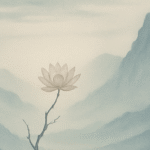
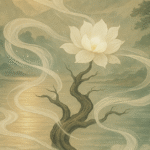
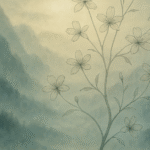
Rootless_Tree_24Chapter#1・Enlarged image of the painting

Enlarged image of the poem below as Xieyi
Chapter 1
▶Original Text
無根樹,花正幽,貪戀紅塵誰肯修?浮生事,苦海舟,蕩去飄來不自由。無邊無岸難泊繫,長在魚龍險處游。肯回首,是岸頭,莫待風波壞了舟。
▶Modern Translation
A flower quietly blooms on a rootless tree.
In this world filled with desire, who will choose the path of self-cultivation?
The course of life resembles a boat adrift on a sea of suffering.
Tossed and swept away, never able to go where one wishes.
There is no end in sight, no shore, no place to anchor one’s vessel.
Always drifting in perilous waters, there is the constant fear of being swallowed by dragons or fish.
But—if only you would look back, you would see the shore lies just behind you.
Before the waves destroy your boat, please awaken.▶Interpretation
This verse offers a quiet yet profound warning: it speaks of human delusion, the potential for awakening, and the peril of missing the right moment.
• “A flower quietly blooms on a rootless tree”:
The subtle and serene beauty of this “faint flower” reflects a depth beyond ordinary perception—a symbol of profound inner stillness moving toward a state of freedom, detached from worldly roots.
• “In this dusty world of desire, who willingly cultivates the Way?”:
A reflection on the reality that few seek self-cultivation when consumed by the whirlpool of cravings.
• “Life is like a drifting boat on the sea of suffering”:
Life, like a water plant, floats uncontrollably, and the image of a boat on a stormy sea conveys a sense of helplessness and lack of freedom.
• “No shore in sight, no anchor to hold”:
This implies that in the worldly realm, there is no certain refuge or foundation—one is always exposed to danger.
• “If you would turn back, you would find the shore”:
A Taoist teaching recalling the classic phrase “Return, and you will find the shore”, pointing to salvation through awakening.
• “Do not wait until the waves destroy your boat”:
A powerful exhortation: wake up before it’s too late.▶Interpretation related to Tai Chi
This poem carries significant lessons for practitioners of Tai Chi as well.
• Do not rely solely on form:
If one becomes intoxicated by external techniques and loses “still power,” the form may appear graceful, but it will eventually collapse.
• Have the courage to choose the path of cultivation:
Rather than chasing praise or flashy forms, it is the quiet, solid practice—often shunned—that leads to true mastery.
• Do not drift—take the helm:
Merely repeating forms mindlessly is meaningless. Without your own internal direction (Qi momentum), you’ll drift without control.
• Danger is ever-present in daily practice:
Even slight negligence can collapse the entire structure of one’s technique. Tai Chi is about always “swimming naturally and effortlessly.”
• Awaken—here and now:
Instead of forcibly doing, we should return to Wu Wei, the state of effortless action. The shore is right behind you—so awaken before it’s too late, in this very moment.
Copyright © MASAKI WAKABAYASHI. All rights reserved.