


Zhuangzi’s Xieyi and Comédie-ballet
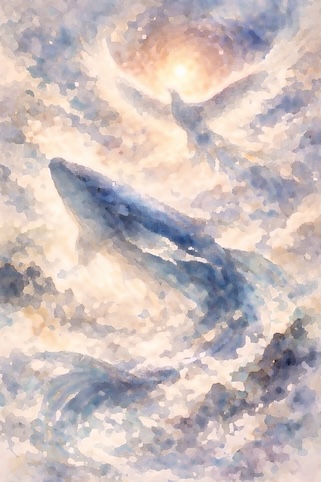 The next work is a Xieyi of Zhuangzi. I will introduce only one work here, but I will announce it when all the works are completed.
Zhuangzi relativized artificial value judgments and fixed order, and preached that true freedom lies in “play”.
Comédie-ballet, which is the prototype of ballet, is not just a form of musical theater, but also occupies an important position in the flow of physical expression in the West as a performing art that establishes “order and deviation” and “play and truth” at the same time.
This structure surprisingly has a deep affinity with Zhuangzi’s thought.
For Jean-Baptiste [de] Lully, who sent a lot of comedy-bare to the world, laughter, paradoxes, masks, and role overturns were important ways to illuminate the essence of the world. Only when people let go of seriousness can they agree with nature (the way) – this way of thinking can be seen as the prototype of the “philosophy of laughter” in later theater and dance.
Comédie-ballet, which was established in France in the 17th century, was an art that realized this “truth as a play” within the court order.
In the works by Lully and Molière, stupidity, vanity and social misunderstanding are presented as laughter, but the laughter does not destroy the order.
Rather, being laughed at reaffirms “selfishness” and “harmony”, and the audience experiences deviation with peace of mind. What is here is a Zhuangzi-like structure in which useless use, that is, seemingly useless games, ultimately support order.
Dance in Comédie-ballet is more eloquent than words.
The body is exaggerated, falls and sometimes comical, all of which is managed within strict musical time.
This “seemingly free, but completely controlled body” leads directly to modern ballet. Lightness, balance, and aerality in classical ballet were born from the stage as a place where laughter and discipline go hand in hand.
Even in modern ballet, the dismantling of narratives, the introduction of everyday movements, and the use of irony and humor are by no means accidental. This is proof that the ideas of “body as play” and “liberation from fixed meanings” since Zhuangzi have been passed down in different forms. Comédie-ballet is not a pastime in the history of Western dance, but the crystallization of a universal artistic attitude that relativizes the world through laughter and the body.
In this way, Zhuangzi’s thought has an affinity for Western performing arts, and he wants to introduce Zhuangzi’s Xieyi paintings to the world, so he is currently working on them.
『Zhuangzi』Beginning of the Getaway
北冥有魚,其名為鯤。鯤之大,不知其幾千里也;化而為鳥,其名為鵬。
……乘天地之正,而御六氣之辯,以遊無窮者,彼且惡乎待哉。
When read aloud, the passage says:
“In the Northern Abyss there is a fish, and its name is Kun.
The vastness of Kun is such that no one knows how many thousand miles it spans.
It transforms and becomes a bird, and its name is Peng.
…
Riding upon the true order of Heaven and Earth,
mastering the transformations of the six vital energies,
one roams freely without limit.
What, then, could such a being possibly depend upon?”
Here, “you” (遊) signifies play, wandering, and free movement—
a state of roaming without bounds (you wu qiong),
an infinite freedom that relies on nothing (wu dai).
This work seeks to give visual form to that idea:
a freedom that is not achieved through force or intention,
but through harmony with the natural flow of Heaven and Earth.
This xieyi painting embodies that vision.
When the entire series is complete,
this work too will be released into the world.


Copyright © MASAKI WAKABAYASHI. All rights reserved.