works

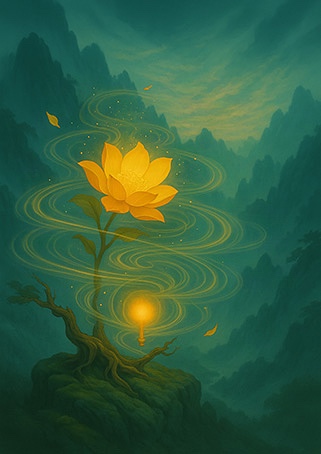
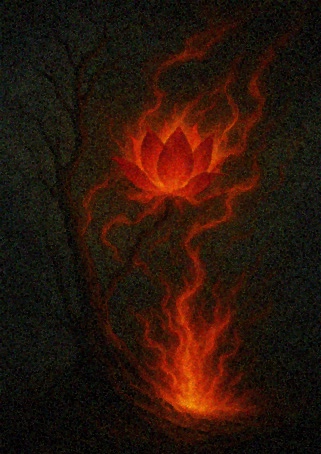
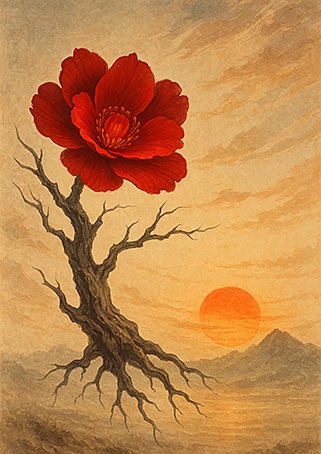
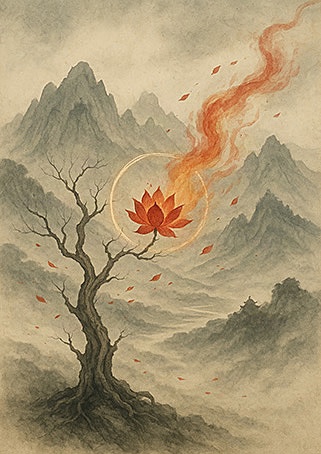
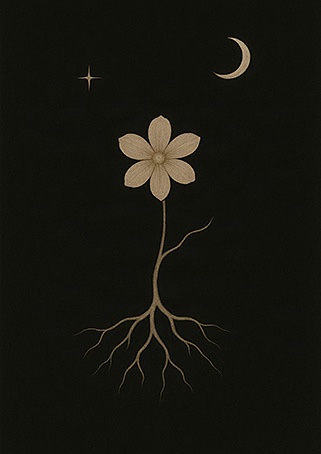
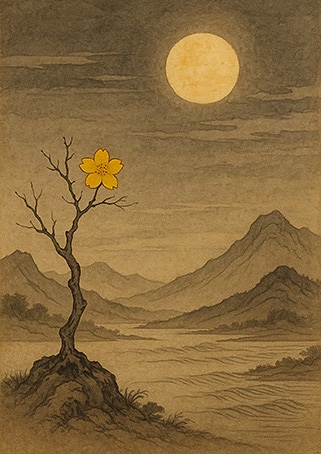
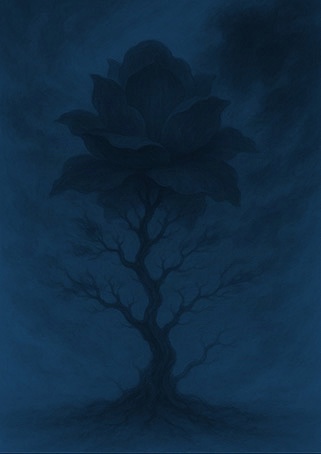
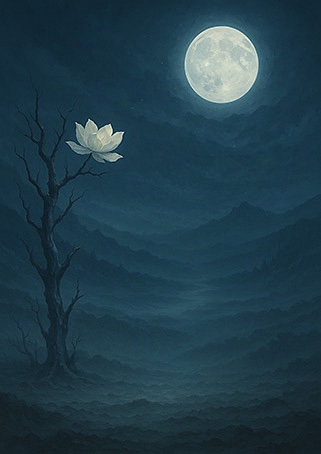
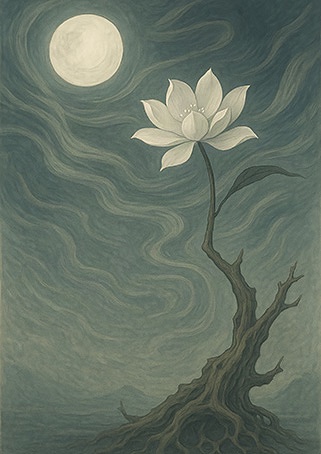
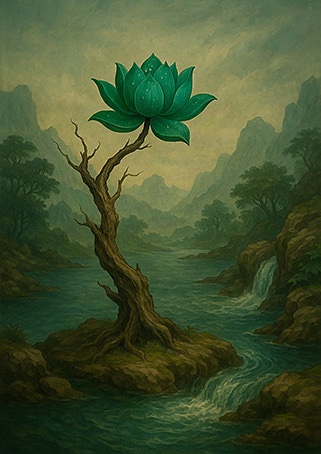
Never Before Seen,A mysterious and beautiful painting , Xieyi that projects the poem of a rootless tree in a painting, the energy of the symbol, and the feng shui effect on the space.

写意画・無根樹100首-第10首#425– 道(タオ)の哲理詩に基づく写意画アート作品
works

Xieyi・The Rootless Tree:100 Verses-Verse 10#425

Xieyi・The Rootless Tree:100 Verses-Verse 10#425  The poems of “The Rootless Tree” express a fundamental force rooted in harmony with heaven and earth, the cyclical flow of yin and yang, and the infinite potential of existence。 This painting is an expressive “Xieyi” in the tradition of “futu” (spiritual diagrams), passed down for generations in Wudang Mountain, China. It is drawn through a technique where energy flow (xingqi) channels the internal intention into visual form。 In the Taoist world, there exist spiritual and symbolic images called “futu”。 These are a type of talisman—not merely religious items, but expressive spiritual paintings that act directly on the mind of the viewer。 Since ancient times, many people have placed […]

写意画・無根樹100首-第31首#305– 道(タオ)の哲理詩に基づく写意画アート作品
works

Xieyi・The Rootless Tree:100 Verses-Verse 31#305

Xieyi・The Rootless Tree:100 Verses-Verse 31#305  The poems of “The Rootless Tree” express a fundamental force rooted in harmony with heaven and earth, the cyclical flow of yin and yang, and the infinite potential of existence。 This painting is an expressive “Xieyi” in the tradition of “futu” (spiritual diagrams), passed down for generations in Wudang Mountain, China. It is drawn through a technique where energy flow (xingqi) channels the internal intention into visual form。 In the Taoist world, there exist spiritual and symbolic images called “futu”。 These are a type of talisman—not merely religious items, but expressive spiritual paintings that act directly on the mind of the viewer。 Since ancient times, many people have placed

写意画・無根樹100首-第3首#429– 道(タオ)の哲理詩に基づく写意画アート作品
works

Xieyi・The Rootless Tree:100 Verses-Verse 3#429

Xieyi・The Rootless Tree:100 Verses-Verse 3#429  The poems of “The Rootless Tree” express a fundamental force rooted in harmony with heaven and earth, the cyclical flow of yin and yang, and the infinite potential of existence。 This painting is an expressive “Xieyi” in the tradition of “futu” (spiritual diagrams), passed down for generations in Wudang Mountain, China. It is drawn through a technique where energy flow (xingqi) channels the internal intention into visual form。 In the Taoist world, there exist spiritual and symbolic images called “futu”。 These are a type of talisman—not merely religious items, but expressive spiritual paintings that act directly on the mind of the viewer。 Since ancient times, many people have placed

写意画・無根樹100首-第31首#311– 道(タオ)の哲理詩に基づく写意画アート作品
works

Xieyi・The Rootless Tree:100 Verses-Verse 31#311

Xieyi・The Rootless Tree:100 Verses-Verse 31#311  The poems of “The Rootless Tree” express a fundamental force rooted in harmony with heaven and earth, the cyclical flow of yin and yang, and the infinite potential of existence。 This painting is an expressive “Xieyi” in the tradition of “futu” (spiritual diagrams), passed down for generations in Wudang Mountain, China. It is drawn through a technique where energy flow (xingqi) channels the internal intention into visual form。 In the Taoist world, there exist spiritual and symbolic images called “futu”。 These are a type of talisman—not merely religious items, but expressive spiritual paintings that act directly on the mind of the viewer。 Since ancient times, many people have placed

写意画・無根樹100首-第34首#435– 道(タオ)の哲理詩に基づく写意画アート作品
works

Xieyi・The Rootless Tree:100 Verses-Verse 34#435

Xieyi・The Rootless Tree:100 Verses-Verse 34#435  The poems of “The Rootless Tree” express a fundamental force rooted in harmony with heaven and earth, the cyclical flow of yin and yang, and the infinite potential of existence。 This painting is an expressive “Xieyi” in the tradition of “futu” (spiritual diagrams), passed down for generations in Wudang Mountain, China. It is drawn through a technique where energy flow (xingqi) channels the internal intention into visual form。 In the Taoist world, there exist spiritual and symbolic images called “futu”。 These are a type of talisman—not merely religious items, but expressive spiritual paintings that act directly on the mind of the viewer。 Since ancient times, many people have placed

写意画・無根樹100首-第35首#313– 道(タオ)の哲理詩に基づく写意画アート作品
works

Xieyi・The Rootless Tree:100 Verses-Verse 35#313

Xieyi・The Rootless Tree:100 Verses-Verse 35#313  The poems of “The Rootless Tree” express a fundamental force rooted in harmony with heaven and earth, the cyclical flow of yin and yang, and the infinite potential of existence。 This painting is an expressive “Xieyi” in the tradition of “futu” (spiritual diagrams), passed down for generations in Wudang Mountain, China. It is drawn through a technique where energy flow (xingqi) channels the internal intention into visual form。 In the Taoist world, there exist spiritual and symbolic images called “futu”。 These are a type of talisman—not merely religious items, but expressive spiritual paintings that act directly on the mind of the viewer。 Since ancient times, many people have placed

写意画・無根樹100首-第19首#441– 道(タオ)の哲理詩に基づく写意画アート作品
works

Xieyi・The Rootless Tree:100 Verses-Verse 19#441

Xieyi・The Rootless Tree:100 Verses-Verse 19#441  The poems of “The Rootless Tree” express a fundamental force rooted in harmony with heaven and earth, the cyclical flow of yin and yang, and the infinite potential of existence。 This painting is an expressive “Xieyi” in the tradition of “futu” (spiritual diagrams), passed down for generations in Wudang Mountain, China. It is drawn through a technique where energy flow (xingqi) channels the internal intention into visual form。 In the Taoist world, there exist spiritual and symbolic images called “futu”。 These are a type of talisman—not merely religious items, but expressive spiritual paintings that act directly on the mind of the viewer。 Since ancient times, many people have placed

写意画・無根樹100首-第13首#331– 道(タオ)の哲理詩に基づく写意画アート作品
works

Xieyi・The Rootless Tree:100 Verses-Verse 13#331

Xieyi・The Rootless Tree:100 Verses-Verse 13#331  The poems of “The Rootless Tree” express a fundamental force rooted in harmony with heaven and earth, the cyclical flow of yin and yang, and the infinite potential of existence。 This painting is an expressive “Xieyi” in the tradition of “futu” (spiritual diagrams), passed down for generations in Wudang Mountain, China. It is drawn through a technique where energy flow (xingqi) channels the internal intention into visual form。 In the Taoist world, there exist spiritual and symbolic images called “futu”。 These are a type of talisman—not merely religious items, but expressive spiritual paintings that act directly on the mind of the viewer。 Since ancient times, many people have placed

写意画・無根樹100首-第4首#340– 道(タオ)の哲理詩に基づく写意画アート作品
works

Xieyi・The Rootless Tree:100 Verses-Verse 4#340

Xieyi・The Rootless Tree:100 Verses-Verse 4#340  The poems of “The Rootless Tree” express a fundamental force rooted in harmony with heaven and earth, the cyclical flow of yin and yang, and the infinite potential of existence。 This painting is an expressive “Xieyi” in the tradition of “futu” (spiritual diagrams), passed down for generations in Wudang Mountain, China. It is drawn through a technique where energy flow (xingqi) channels the internal intention into visual form。 In the Taoist world, there exist spiritual and symbolic images called “futu”。 These are a type of talisman—not merely religious items, but expressive spiritual paintings that act directly on the mind of the viewer。 Since ancient times, many people have placed

写意画・無根樹100首-第7首#341– 道(タオ)の哲理詩に基づく写意画アート作品
works

Xieyi・The Rootless Tree:100 Verses-Verse 7#341

Xieyi・The Rootless Tree:100 Verses-Verse 7#341  The poems of “The Rootless Tree” express a fundamental force rooted in harmony with heaven and earth, the cyclical flow of yin and yang, and the infinite potential of existence。 This painting is an expressive “Xieyi” in the tradition of “futu” (spiritual diagrams), passed down for generations in Wudang Mountain, China. It is drawn through a technique where energy flow (xingqi) channels the internal intention into visual form。 In the Taoist world, there exist spiritual and symbolic images called “futu”。 These are a type of talisman—not merely religious items, but expressive spiritual paintings that act directly on the mind of the viewer。 Since ancient times, many people have placed

Scroll to Top